New South Wales · Tariffs
Ausgrid capacity charges: why one afternoon can cost you for 12 months (2026–27)
On Ausgrid's large business tariff EA305, the network charges a capacity charge of 57.80 cents per kVA per day (2026–27, excluding GST). It is set by the highest 30-minute demand your site has drawn between 3pm and 9pm on a weekday in the last 12 months. Unlike a monthly demand charge, one busy afternoon can set this line of your bill for a full year.
Who is on EA305?
Ausgrid runs the electricity network across Sydney, the Central Coast and the Hunter. EA305 is its tariff for low-voltage business sites using roughly 160 to 750 MWh a year: a large supermarket, a cold store, a factory or a commercial building. Smaller sites (about 40 to 160 MWh) are usually on EA302 and larger ones on EA310. Both also carry a capacity charge on a rolling 12-month basis, at different rates. Check the network tariff code on your bill.
How the capacity charge works
- The window: 3pm to 9pm on weekdays, every month of the year.
- The reading: the highest 30-minute average demand in that window, in kVA.
- The rolling year: the chargeable capacity is the highest reading in the previous 12 months, including the current month. It rises as soon as a new peak is set, and only falls when a peak is more than 12 months old.
- The bill: you pay 57.80 c per kVA for every day of the billing period, whether or not the site came close to that peak.
| EA305 charge (2026–27, excl. GST) | Rate | When it applies |
|---|---|---|
| Capacity | 57.80 c per kVA per day | Set by the highest half-hour, 3pm–9pm weekdays, previous 12 months |
| Peak energy | 8.23 c/kWh | 3pm–9pm weekdays, November–March and June–August |
| Off-peak energy | 1.85 c/kWh | All other times |
| Network access | 2,546.54 c per day | Fixed |
57.80 c per kVA per day works out to about A$211 per kVA per year, or roughly A$17.60 per kVA per month.
A worked example
A site whose highest weekday-afternoon half-hour in the past year was 150 kVA pays about 150 × 57.80 c × 365 days = A$31,650 a year in capacity charges. Every 10 kVA of that peak is worth about A$2,100 a year.
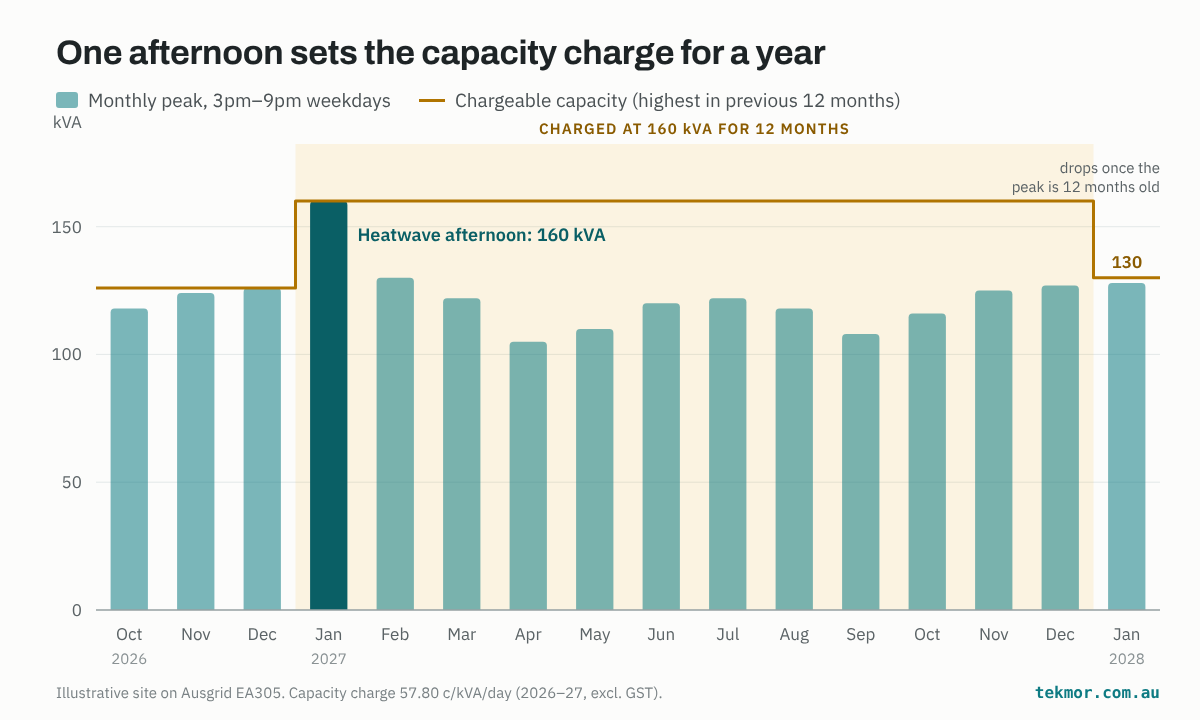
This is the key difference from a monthly demand charge, such as Energex's in Queensland (see how Energex demand charges work). There, a bad day costs you one month. On EA305, it costs you twelve.
What this means for running a battery
- Every weekday counts, all year. The capacity window has no off-season, so a battery has to protect 3pm–9pm on around 250 weekdays a year, not just through summer.
- Six hours is a long window. Holding a site 30 kW lower for the full six hours takes about 180 kWh of stored energy, before losses. Sizing and daily planning both need to account for the length of the window, not just its height.
- Reliability is worth more than average performance. A battery that is offline, under maintenance or flat on one hot afternoon can undo a year of good days. Schedule maintenance, firmware updates and testing outside weekday afternoons.
- Watch new loads. New equipment, EV chargers or commissioning tests run on a weekday afternoon can set a new 12-month peak in a single half-hour.
- Build the lag into the business case. Savings only start when the old peak rolls out of the 12-month window, so the first-year benefit can be well below the steady-state figure.
How to check your own exposure
Find the capacity charge line on your latest bill, in kVA, and multiply by about A$211 to see what it costs over a year. Then ask your retailer for 12 months of 30-minute interval data (NEM12). It shows which afternoon set your capacity, how far above a normal day it was, and whether a battery, a change to how equipment is scheduled, or power factor correction would have avoided it.
Frequently asked questions
Does the Ausgrid capacity charge reset every month?
No. On EA305 the chargeable capacity is the highest 30-minute demand between 3pm and 9pm on a weekday over the previous 12 months, including the current month. A higher reading takes effect straight away; it only drops out once 12 months have passed without it being exceeded.
Can I ask Ausgrid to reset my capacity?
Only for a permanent reduction in the site's capacity that is expected to last at least 12 months. The request goes through your retailer, and Ausgrid allows one reset a year. A temporary drop, such as a quiet month, does not qualify.
Do weekends count?
No. The capacity window is 3pm to 9pm on weekdays, all year round. Weekend demand does not set the capacity charge.
Does the EA305 peak energy rate apply all year?
No. The peak energy rate (8.23 c/kWh in 2026–27) applies from 3pm to 9pm on weekdays in summer (November to March) and winter (June to August). April, May, September and October are charged at the off-peak rate. The capacity charge, by contrast, applies all year.
If I install a battery, when does my capacity charge fall?
Only once the old peak drops out of the 12-month window. If your highest reading was last January, the charge stays at that level until the following January, however well the battery performs in between. Payback estimates should allow for this lag.
Sources
- Amber Electric: Ausgrid Business Tariffs FY2026-27 (EA305 rates and windows)
- Ausgrid: ES7 Network Price Guide (capacity charges, rolling 12-month rule and resets)
- Ausgrid: Network prices
Network rates are Ausgrid's 2026–27 rates excluding GST, as published; your retailer's bill may show them differently. The chart is an illustrative example, not customer data. This article is general information, not financial advice.
See what your site could save.
Send one electricity bill. We'll compare the options and recommend the best-value plan, free.